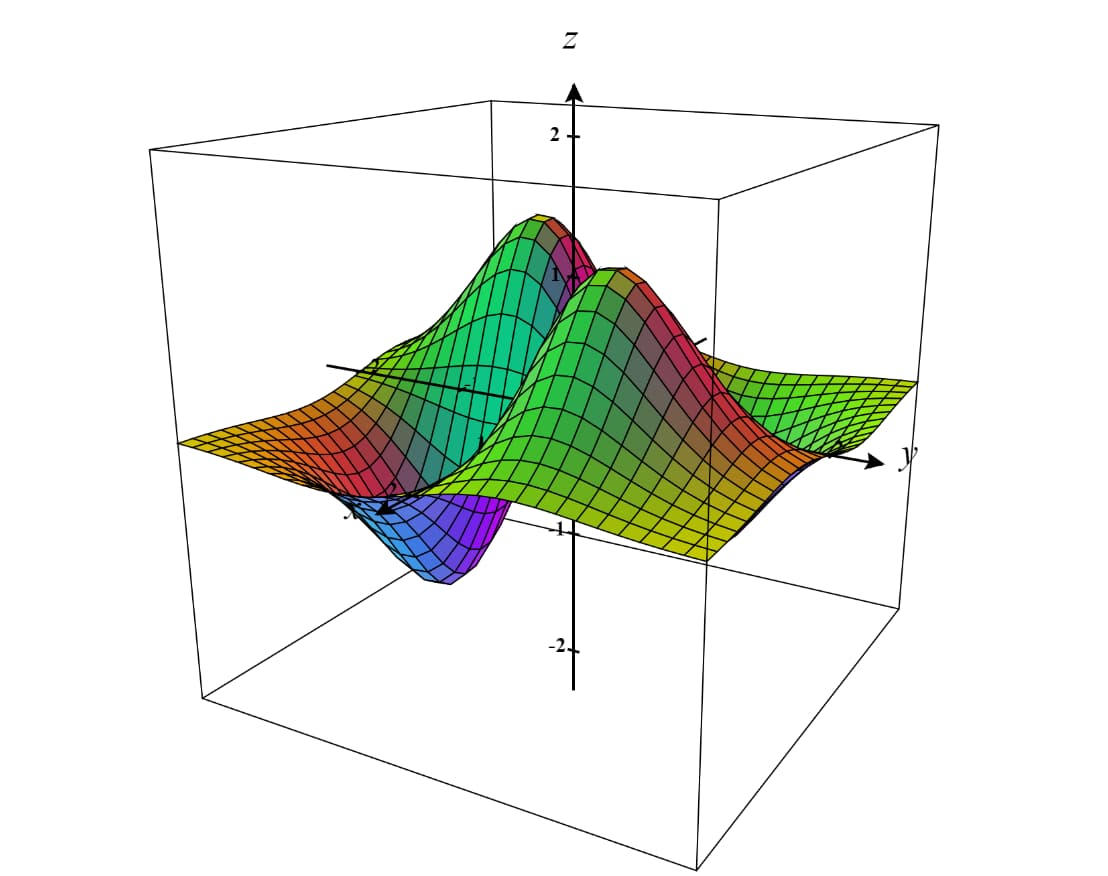
Curl and Divergence
The two ways to apply ∇ to a vector field — divergence (a scalar) and curl (a vector).
The setup. Both are ∇ applied to a vector field — one as a dot product, one as a cross product. Each extracts a different physical feature of the field.
Ready to put it into practice?
Start practicingPhysical meaning: positive divergence means the point acts like a faucet (field flows outward); negative means a drain. In EM this is Gauss's law territory — divergence of the E-field tells you where charge is. ∇·E = ρ/ε₀: charge is the source of the field's divergence.
Divergence — measures how much the field spreads out from a point (a source) or flows in (a sink)
- Divergence — a scalar, one number at each point.
Curl measures the rotation or "swirl" of the field at a point:
Curl, as a determinant
- Curl — a vector, with its own i, j, k components.
Physical meaning: curl points along the axis a tiny paddlewheel placed in the field would spin around, and its magnitude is how fast. Zero curl means no swirl (irrotational).
Curl, expanding the determinant
- Zero curl — no swirl anywhere in the field.
The two facts that tie it together. A conservative field has zero curl: if F = ∇f, then ∇×F = 0. So curl is the test for conservative — swirl-free is a necessary condition. (This is why the ∂P/∂y = ∂Q/∂x check from the vector-fields section worked: it's exactly the 2D curl being zero.)
A curl field never has sources — this is always true, for any field F, not just conservative ones.
Divergence of a curl is always zero
Worked example
Divergence: sum the three matching partials.
Curl, i-component.
Curl, j-component.
Curl, k-component.
Assemble the three components. Since the curl isn't zero, F is not conservative.
Answer:
How to solve one of these
- 1.
Identify P, Q, R. The three component functions of the field.
- 2.
Divergence: sum the three matching partials. . Result is a scalar.
- 3.
Curl: set up the ijk determinant and expand, or use the component formula. Result is a vector.
- 4.
Watch the cross-partials in curl. Each component is (partial of the later variable) minus (partial of the earlier). Sign errors live here.
- 5.
Interpret. Zero curl means possibly conservative; the sign of divergence means a source or a sink.
Divergence (∇·F) is a scalar measuring source/sink; curl (∇×F) is a vector measuring rotation. Curl zero means possibly conservative; divergence of a curl is always zero.
Ready to put it into practice?
Start practicingWant the rest of Calc III? Leave your email and I'll tell you the day the pack's live.