Double Integrals
Evaluate iterated double integrals of a polynomial over a rectangular region.
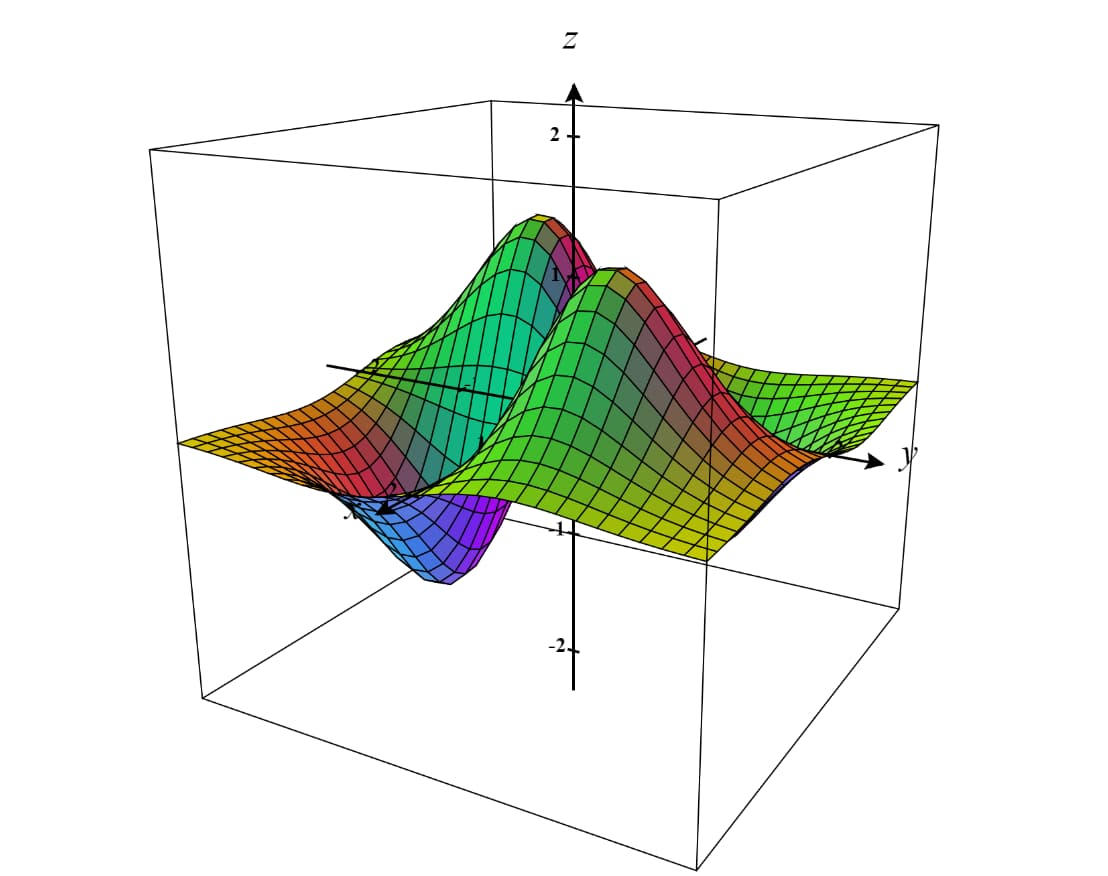
A single integral adds up infinitely many thin slices to get the area under a curve. A double integral does the same thing one dimension up: it adds up infinitely many thin vertical slabs to get the volume under a surface z = f(x, y).
Ready to put it into practice?
Start practicingFormally, it's the limit of a sum over a fine grid partition of the rectangle into m x n small patches, each of area ΔA:
Double integral as a limit of Riemann sums
- Double integral over the region R — add up contributions across the whole 2D region.
- The integrand: the function whose values are being summed.
- An infinitesimal patch of area — the 2D equivalent of dx.
- Let the grid get finer in both directions at once: more columns (m) and more rows (n).
- Sum over the m columns of the grid — the x-direction.
- Sum over the n rows of the grid — the y-direction.
- The function's value at a sample point inside grid cell (i, j).
- The area of each grid cell — the same for every cell, since the grid is uniform.
- The width of each grid column.
- The height of each grid row.
A general region doesn't tile so neatly, so its Riemann sum is usually written as a single sum over irregular patches. A rectangle tiles into a uniform grid, so the same idea splits cleanly into the double sum above — one index for columns, one for rows.
That definition works over any region, but it isn't something you evaluate directly. Over a rectangle, it reduces to two ordinary single-variable integrals done back to back:
This is an iterated integral — the exact form used in the practice problems below:
Iterated integral (rectangular region)
- Outer integral: sweep y from c to d.
- Inner integral: sweep x from a to b, with y momentarily fixed.
- The integrand, evaluated at each (x, y) point as the sweep proceeds.
- Integrate with respect to x first, holding y constant.
- Then integrate that result with respect to y.
Over a rectangle [a, b] x [c, d], the order of integration doesn't change the result:
Fubini's theorem (rectangular region)
- Double integral over the rectangle formed by x in [a,b] and y in [c,d].
- Cartesian product: pairs every x in [a,b] with every y in [c,d] to form the rectangle.
- The same integrand throughout — Fubini's point is that its integral doesn't depend on which variable you integrate first.
- The area element from the double-integral definition, which the iterated integral reproduces exactly.
- Outer integral: sweep y from c to d.
- Inner integral: sweep x from a to b, with y momentarily fixed.
- Integrate with respect to x, holding y constant.
- Integrate with respect to y, holding x constant.
Fubini's theorem guarantees both orders agree when the region is a rectangle (or more generally, when neither pair of bounds depends on the other variable) and f is continuous on it. That's also what the visualization below is demonstrating: sweep along x, then along y, and the running sum converges to the same exact total either way. Once a region has curved or variable boundaries, swapping the order of integration means swapping the limits too, not just relabeling dx and dy.
Worked example
Inner integral first, with respect to y, holding x frozen — the 6x^2 factor is constant here, so it just comes along for the ride. Once evaluated, the y is gone: the inner integral eats one variable and hands back a function of x alone.
Outer integral, with respect to x, finishes the job.
Now do it in the other order, because Fubini says you may — inner integral with respect to x this time, holding y fixed.
Then the outer integral with respect to y. Same answer — that's not a coincidence, it's the theorem.
A third way: 6x^2y separates into g(x)h(y), so the double integral is just the product of two single integrals.
Answer:
How to solve one of these
- 1.
Identify the region. Read off (the -bounds) and (the -bounds) from .
- 2.
Choose the order. Fubini says either works. Pick the one that makes the inner integral easier — or if the integrand factors as , skip ahead to step 6.
- 3.
Write the iterated integral with matched bounds. Inner differential pairs with inner bounds — inner means the -bounds go on the inner sign. This is where most errors happen.
- 4.
Evaluate the inner integral. Treat the other variable as a constant — it factors out exactly like a number would. Substitute the limits. The inner variable disappears.
- 5.
Evaluate the outer integral. You now have a single-variable integral. Do it. Substitute the limits. You have a number.
- 6.
(Shortcut) If and is a rectangle, compute instead. Rectangle only.
- 7.
Check. Redo it in the opposite order. Fubini guarantees agreement, so a mismatch means you made an arithmetic error — not that the theorem failed. Step 7 is the one no textbook lists and every student needs: it turns Fubini from a fact you memorize into a tool you use.
Slice the region into tiny rectangles, multiply each by the function's value there, and add every last one up.
Ready to put it into practice?
Start practicingWant the rest of Calc III? Leave your email and I'll tell you the day the pack's live.