Partial Derivatives
Differentiate a multivariable function with respect to one variable while holding the others constant.
The idea. A partial derivative asks: how fast does f change if I nudge one variable and hold the rest still? That's it. Everything else is bookkeeping.
Ready to put it into practice?
Start practicingLimit definition — the honest one, which you'll be asked to write once and then never use again:
Partial derivative, limit definition
Notice b never changes. You're walking in the x-direction only.
Notation. All of these mean the same thing, and your professor will use several without warning:
Equivalent notations for the partial derivative
The ∂ is a "rounded d" — Thompson's a little bit of, but flagged to say other variables are being held frozen.
The working rule. To find f_x, treat y as a constant and differentiate normally. Every single-variable rule still applies — power, product, quotient, chain. A y sitting in a term is just a number that happens to be spelled with a letter.
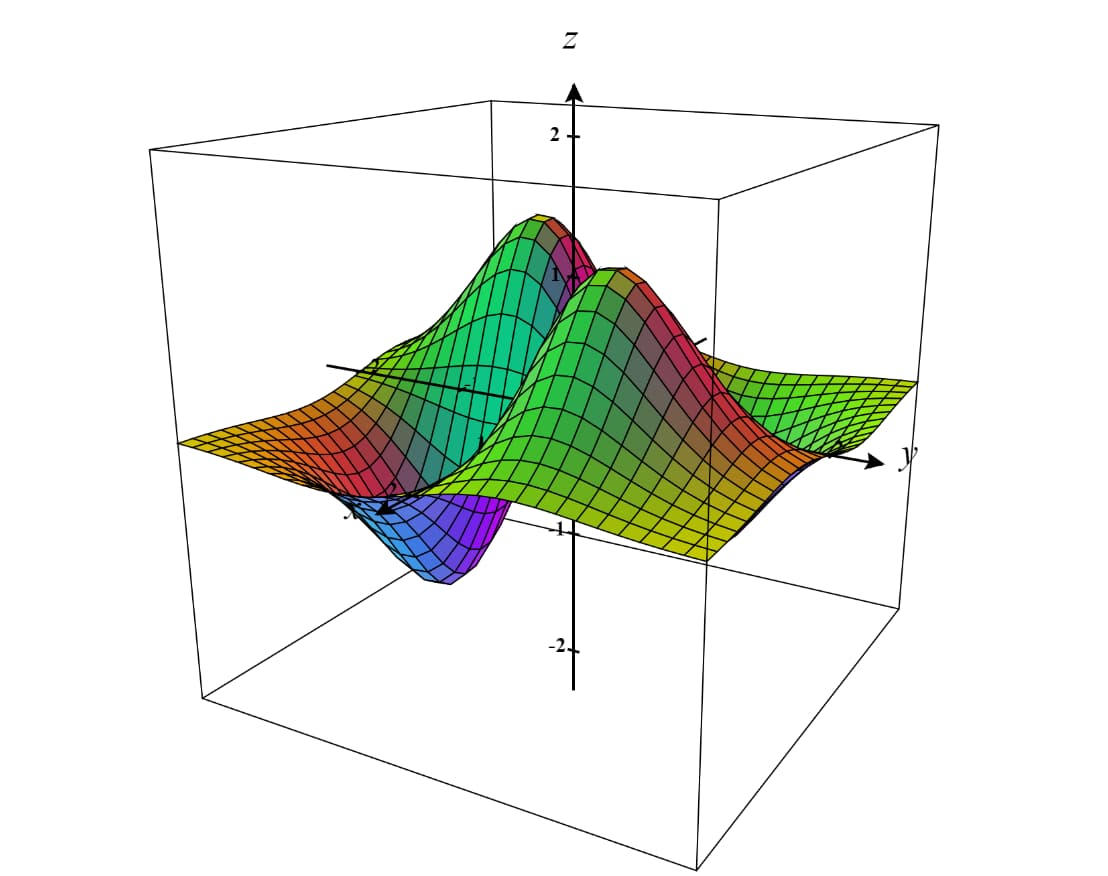
Geometric meaning, and this is where it connects to your 3D viz: slice the surface z = f(x, y) with the vertical plane y = b. You get a curve. f_x(a, b) is the slope of that curve at x = a. Slicing with x = a instead gives you f_y. Same slicing move that makes Fubini visible.
Second-order partials. Differentiate twice:
Second-order partials
Read the order carefully — this is a real trap. f_xy means x first, then y: left to right. But ∂²f/∂y∂x means the same thing read right to left, inner to outer. The two notations run in opposite directions.
Clairaut's theorem. If f_xy and f_yx are both continuous near (a, b), then:
Clairaut's theorem
Mixed partials don't care about order. Same flavor as Fubini — a hypothesis of continuity buying you permission to swap. Worth pointing that parallel out; it's not a coincidence, and it's the kind of thing that makes a course cohere. (And like Fubini, it can fail without continuity. Rare, real, not on your exam.)
Worked example
f_x — hold y constant. In x^3y^2, the y^2 is a constant multiplier, so it survives untouched while x^3 becomes 3x^2. In -4xy, the -4y is a constant, and x becomes 1. The 7y has no x at all, so it's a constant, and its derivative is zero.
f_y — now hold x constant. In x^3y^2, the x^3 rides along while y^2 becomes 2y. In -4xy, the -4x is constant. And 7y becomes 7.
Mixed partials, both orders. Differentiate f_x with respect to y.
Differentiate f_y with respect to x. Equal — Clairaut, confirmed on a live example.
Answer:
How to solve one of these
- 1.
Identify which variable you're differentiating with respect to. The subscript or the denominator tells you. Everything else is frozen.
- 2.
Scan each term for the active variable. A term with no in it contributes nothing to — its derivative is zero.
- 3.
Pull constants out. Any factor made only of the frozen variables is a numeric coefficient. in behaves exactly like a 5 would.
- 4.
Apply the ordinary single-variable rules to what's left. Power rule, product, chain — nothing new.
- 5.
Reassemble term by term. Don't try to do the whole expression at once.
- 6.
For higher-order partials, work inside-out. One differentiation at a time, and write down which variable you used at each step.
- 7.
Check with Clairaut's theorem. Compute and independently. If they disagree, you made an arithmetic error — the theorem holds for anything you'll see in this course.
How fast f changes as x alone nudges up, with every other variable frozen in place.
Ready to put it into practice?
Start practicingWant the rest of Calc III? Leave your email and I'll tell you the day the pack's live.