Surface Area
The surface area of z = f(x, y) over a region D, via a double integral.
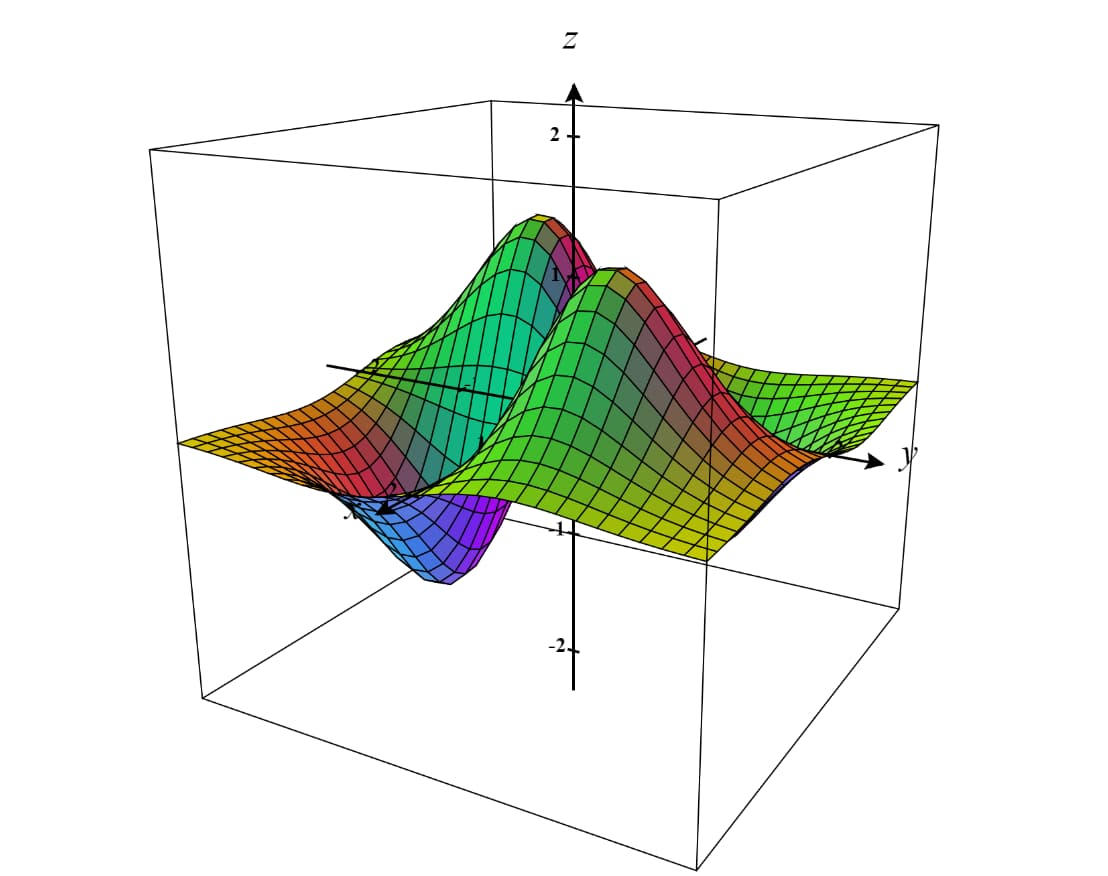
Different flavor from the rest of this section — geometry, not mass. For a surface z = f(x, y) sitting over a region D, its area is:
The square root is a stretch factor: a tilted patch of surface covers more area than its flat shadow on D, and the steeper the tilt, the more stretch.
Surface area of z = f(x,y) over D
- Partial derivatives of f — the surface's slopes; feed the stretch factor.
- An infinitesimal patch of area in the shadow region D.
- The actual area of the surface S, not just the flat shadow D.
Where the square root comes from: f_x and f_y are the surface's slopes in the two directions. If the surface is flat (f_x = f_y = 0), the root is 1 and you just get the area of D, as you'd hope.
The trap here: it's f_x² and f_y² under the root, plus one, all square-rooted. Not √(1 + f_x + f_y), not 1 + √(f_x² + f_y²). Miss the structure and every surface-area problem is wrong.
How to solve one of these
- 1.
Compute the partial derivatives first. Find and , square them, add 1, take the root — then integrate the result over .
- 2.
Set up the region as in Type I, Type II, or polar form. Applications don't change how you integrate over the region , only what you integrate.
Stretch the shadow region's area by how tilted the surface is at each point, then add it all up.
Want the rest of Calc III? Leave your email and I'll tell you the day the pack's live.